"Work created during employment at Oracle Financial Services. Shown here for portfolio purposes only. All product names, trademarks, and intellectual property belong to Oracle Corporation."
OUTCOMES
What the design was built to achieve
Targets set before handoff — to be validated post-launch
TARGET
50%
reduction in validation cycle time — 30 min → 15 min per deployment
TARGET
95%
target validation pass rate — up from ~80% with manual processes
TARGET
1
tool
replacing Jenkins, Grafana, Prometheus, OCI Console and Bastion Host for validation
Targets above are illustrative — defined during the Redwood UCD success criteria phase and to be validated against actual usage post-launch. The product was in active development at the time of my departure from Oracle OFSS.
Closed the validation gap
The core problem the stakeholder named — users cannot verify whether deployments succeeded — is directly addressed. Automated validation results replace 20–25 min of manual kubectl work per deployment cycle.
Management visibility without ops dependency
VPs see customer temperature and global deployment health on login — without manually chasing the ops team for status. The governance blind spot the engineering lead identified is resolved by design.
Other screens in the dashboard
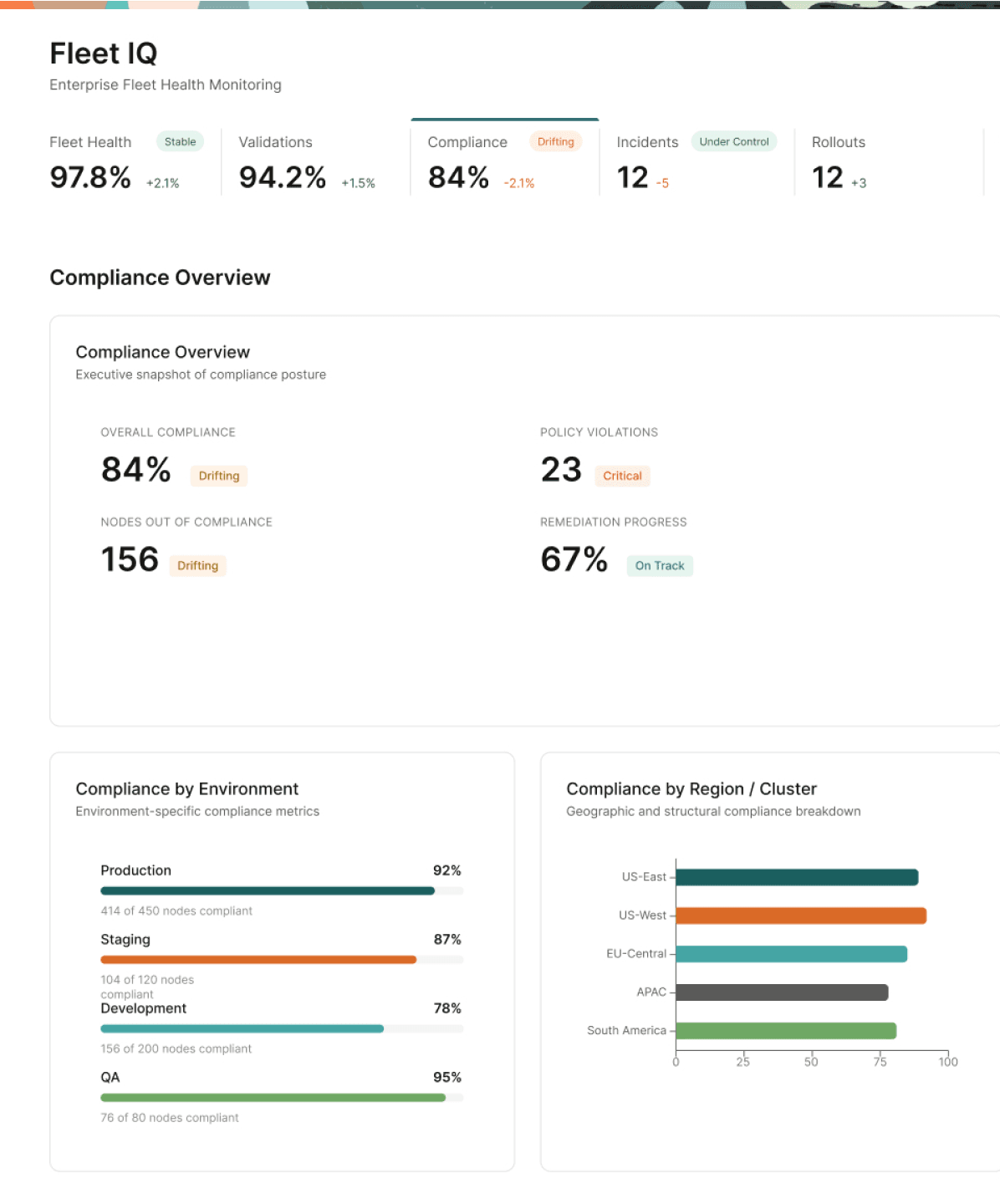
Compliance
Overall compliance posture — score, drifting nodes, top risks by severity
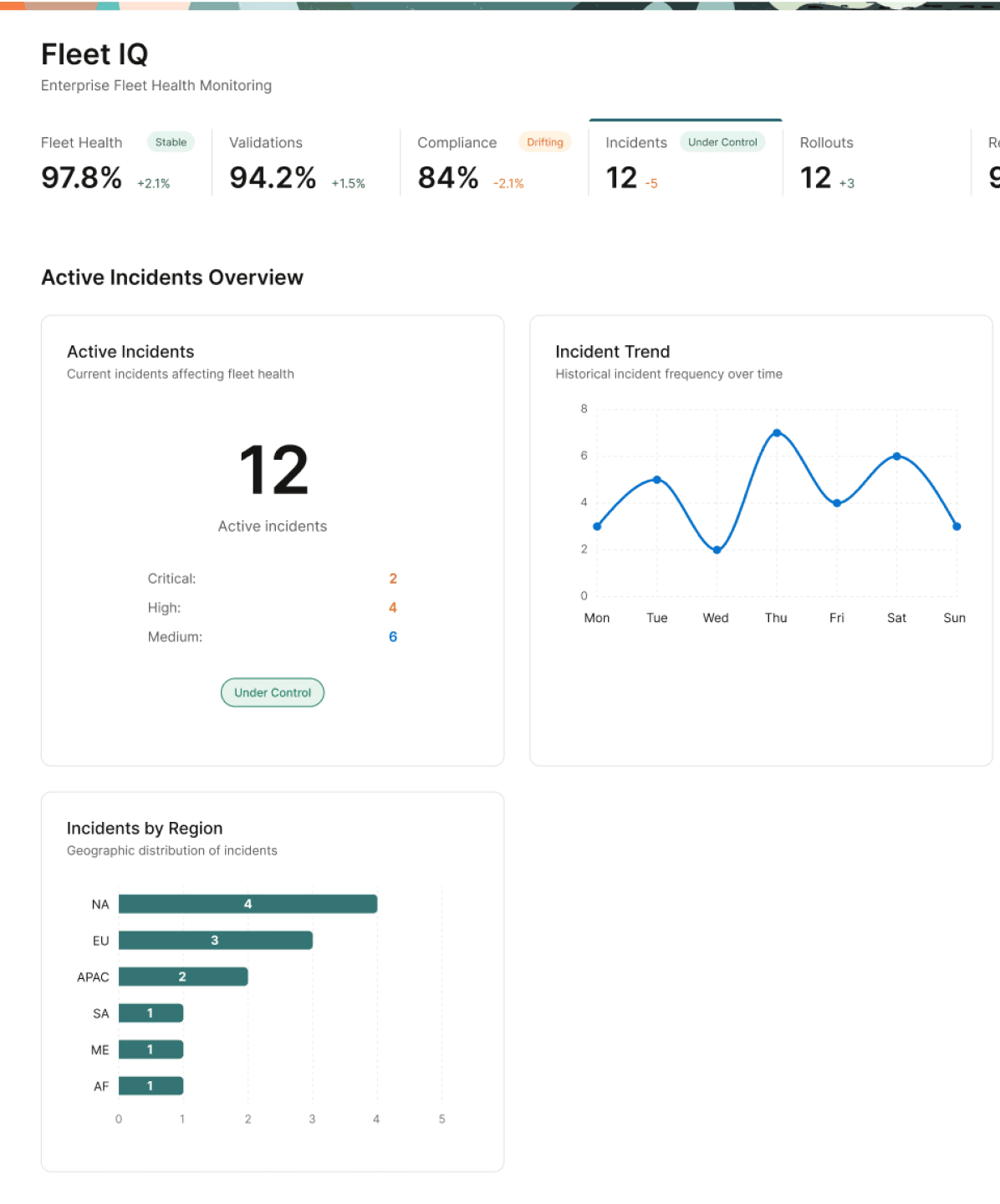
Incidents
Active incidents by severity, trend frequency, geographic distribution by region
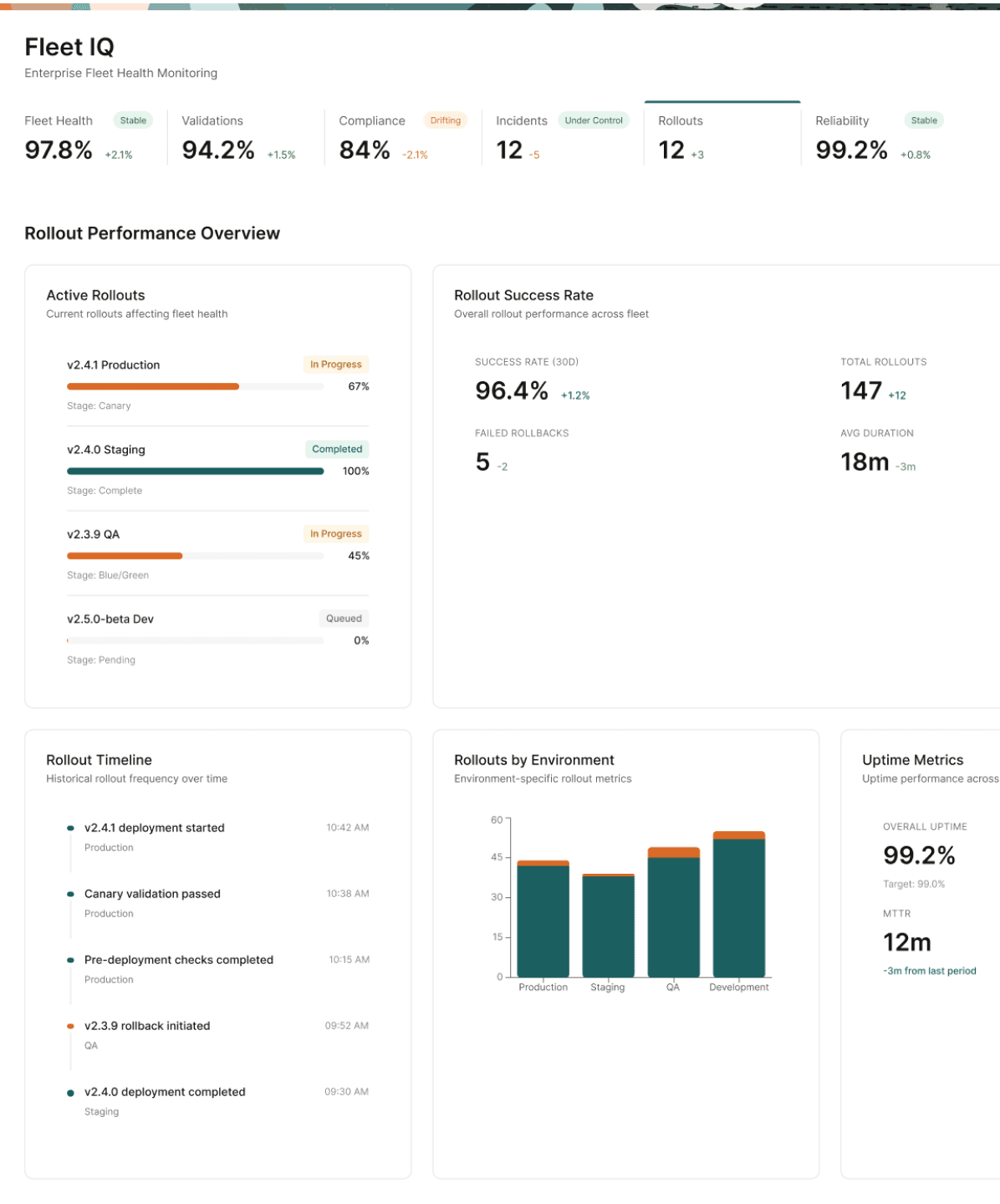
Rollouts
Active rollout progress, timeline audit trail, uptime metrics and SLA targets
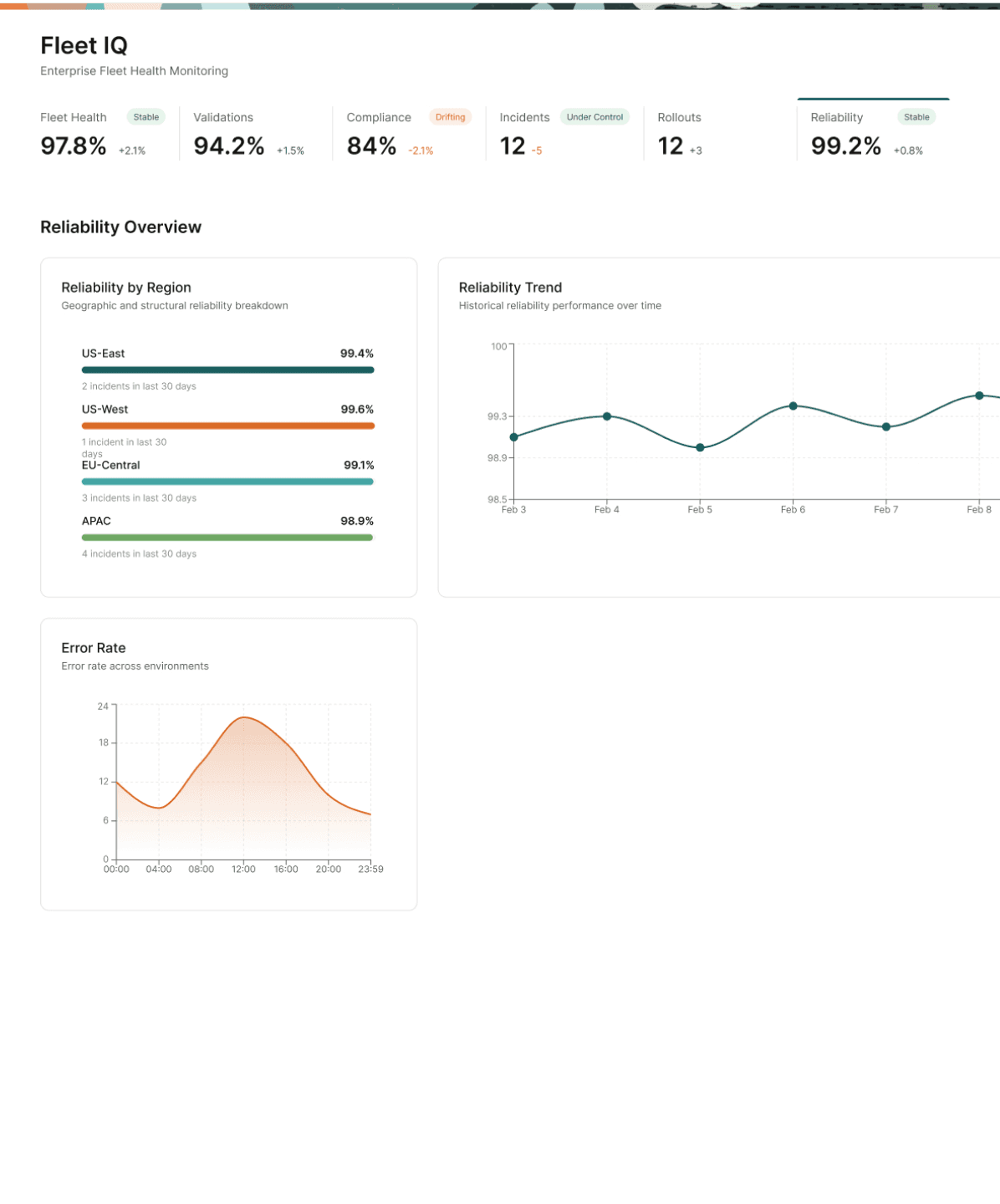
Reliability
Reliability by region, error rate trend across environments, historical performance
DESIGN
What was designed and why
Each dashboard tab resolves a specific gap identified in stakeholder interviews. The design translates research findings directly into interface decisions — screen by screen.
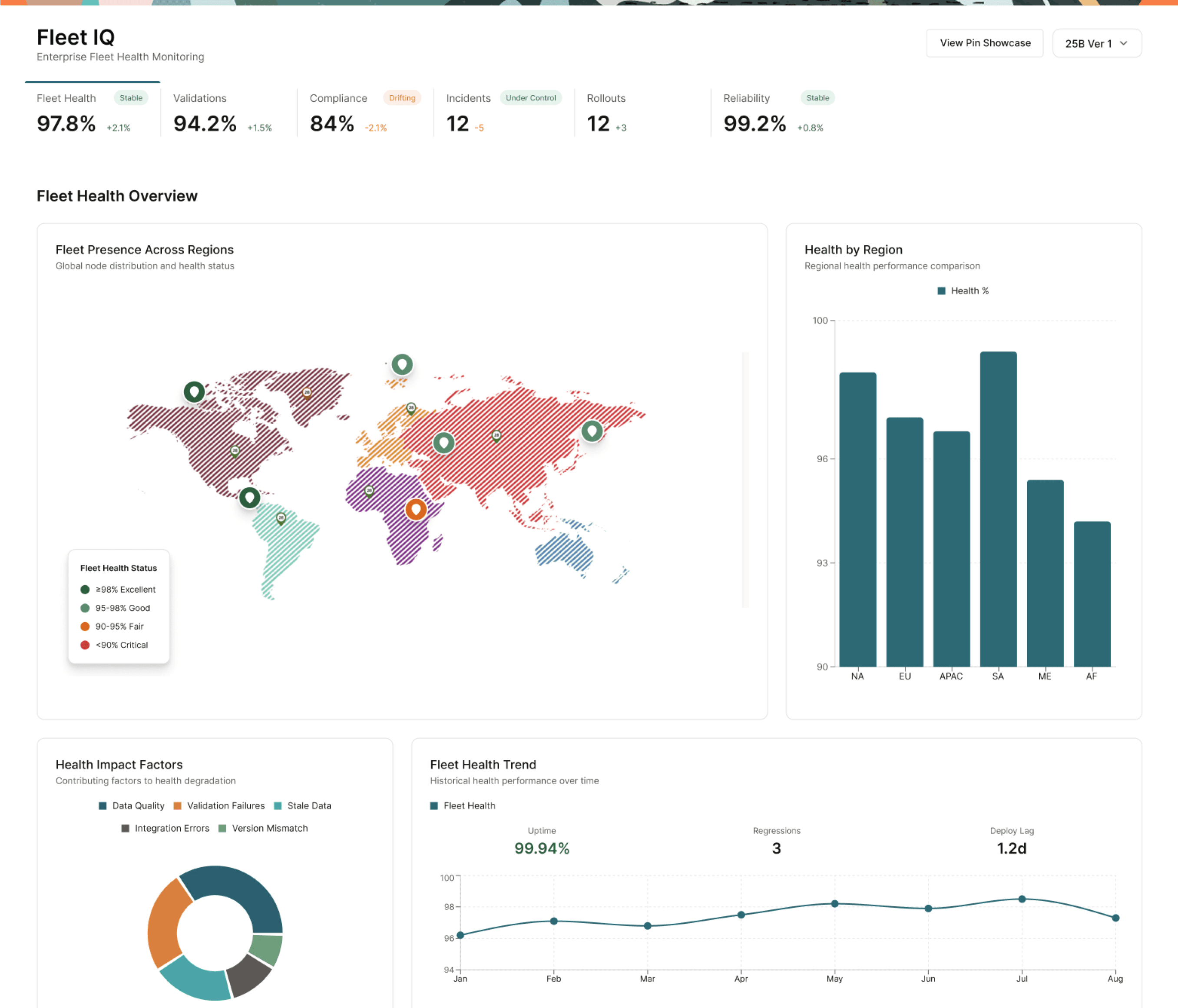
Fleet Health · VP + Ops Lead
World map — requested directly by the engineering lead
↗
Colour-coded health pins (Excellent / Good / Fair / Critical) match the geographic mental model ops teams already use — no translation required
↗
Hover tooltip shows nodes, health %, and active incidents per region — eliminates page navigation for a quick status check
↗
Health Impact Factors donut surfaces the why — Data Quality, Validation Failures, Stale Data — not just what is failing
↗
Fleet Health Trend line (Jan–Aug) shows trajectory — a slight decline triggers investigation before SLA breach
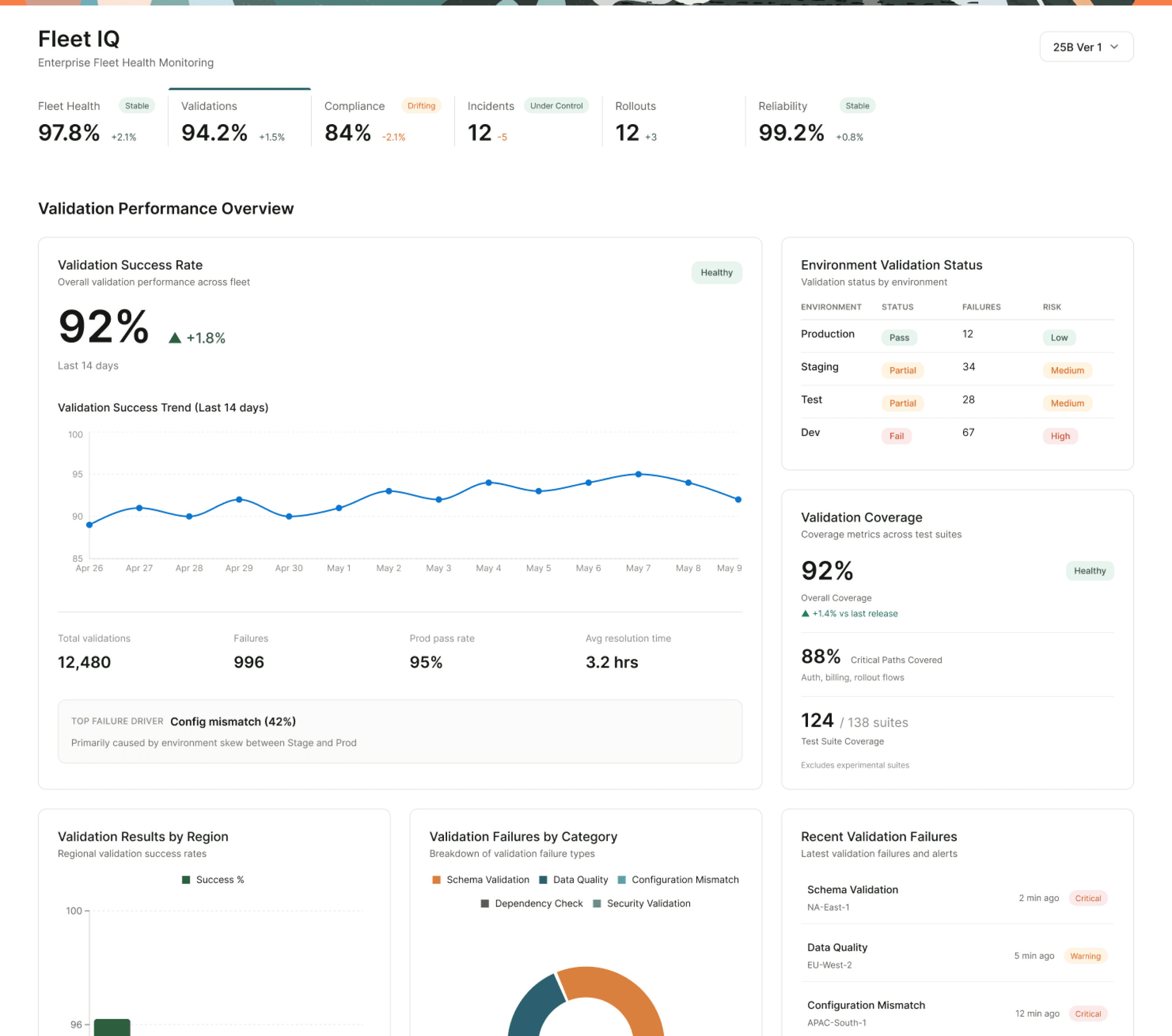
Validations · AMS Engineer + SRE
Closing the release validation gap — the core problem
↗
Directly addresses the gap Engineering Lead named — users had no way to verify deployments succeeded. Validation results are now automated and surfaced in one place
↗
Validation Success Rate (92%, +1.8%) with 14-day trend — Priya gets confidence without running any kubectl commands on Bastion Host
↗
Top Failure Driver — Config mismatch 42% — single most actionable insight, visible without scrolling, first fold
↗
Environment table (Production · Staging · Test · Dev) with Pass/Partial/Fail badges replaces Priya's 4-tool manual comparison — from 20–25 min to a single glance
DISCOVERY
My role in research
Discovery combined stakeholder interviews with Engineering Lead and Vice president alongside Oracle's Redwood UCD 6-question framework. All outputs were validated in Figma templates before any design work began.
Current experience — As-Is Script
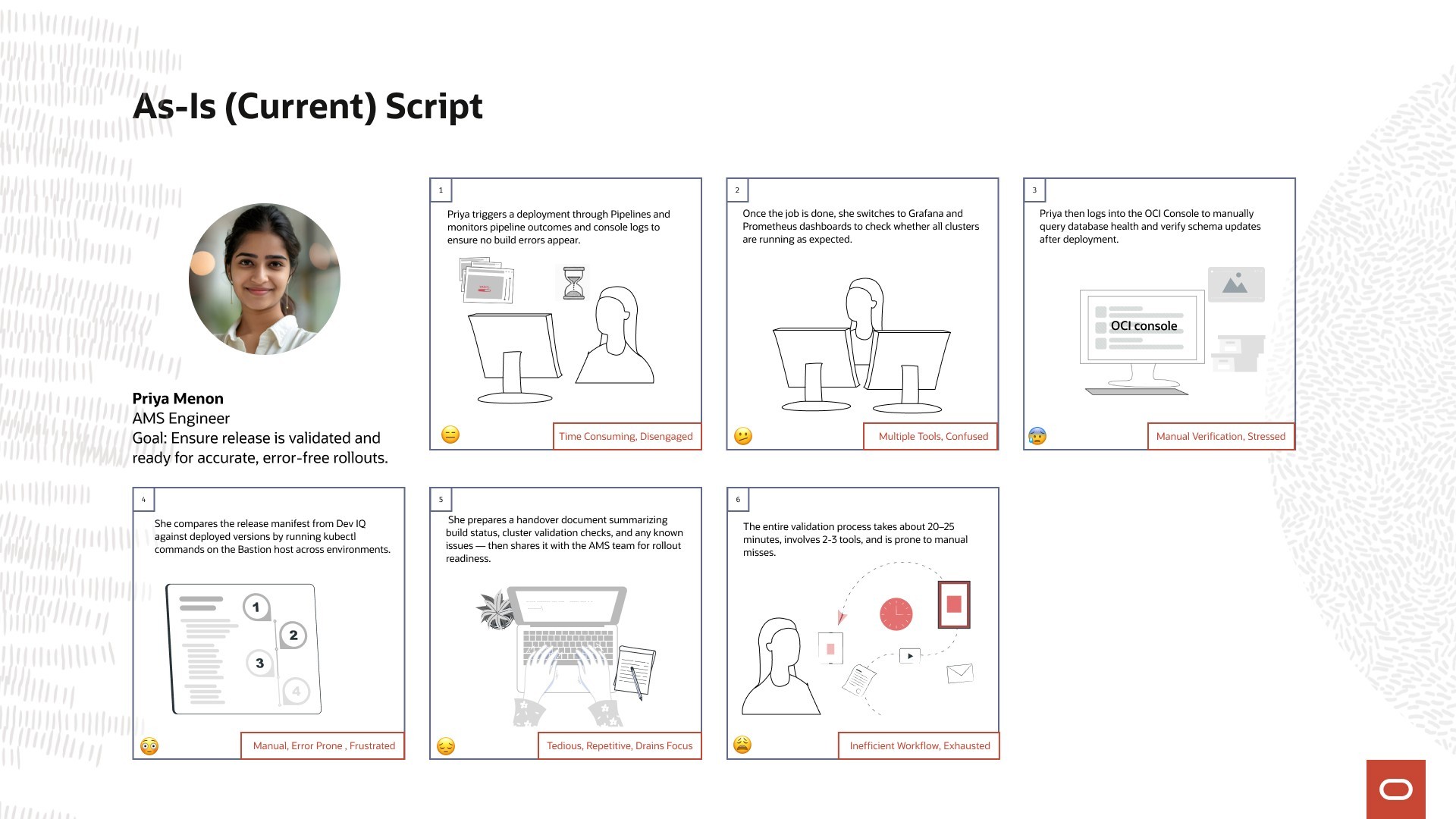
As-Is script — 6-step manual validation workflow across Bastion Host, Grafana, Prometheus, and OCI Console. 20–25 min per cycle, prone to manual misses. Confirmed by engineering lead in stakeholder interviews.
Who are we designing for - Personas
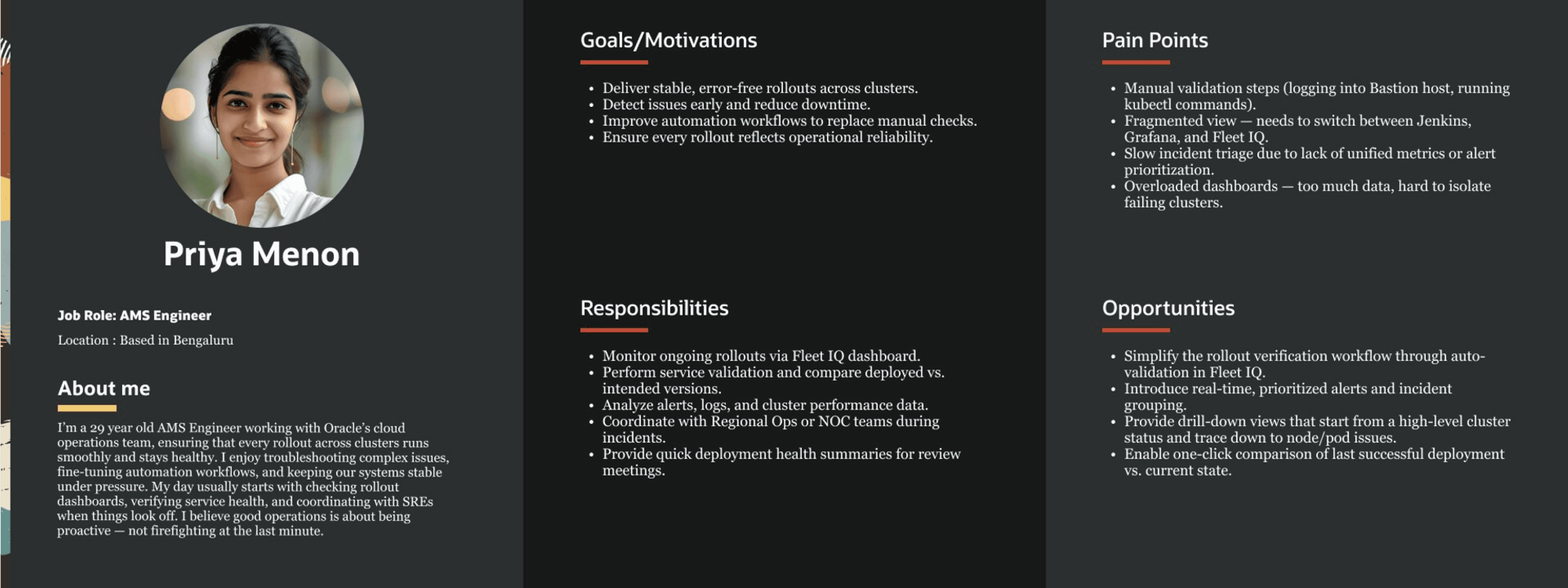
"Primary persona — Priya Menon, AMS Engineer. Two additional personas were developed as part of the Redwood UCD process: Marcus Reed (Regional Ops Lead) and Alex Morgan (Program Manager — Cloud Operations)."
The situation to improve - User journey
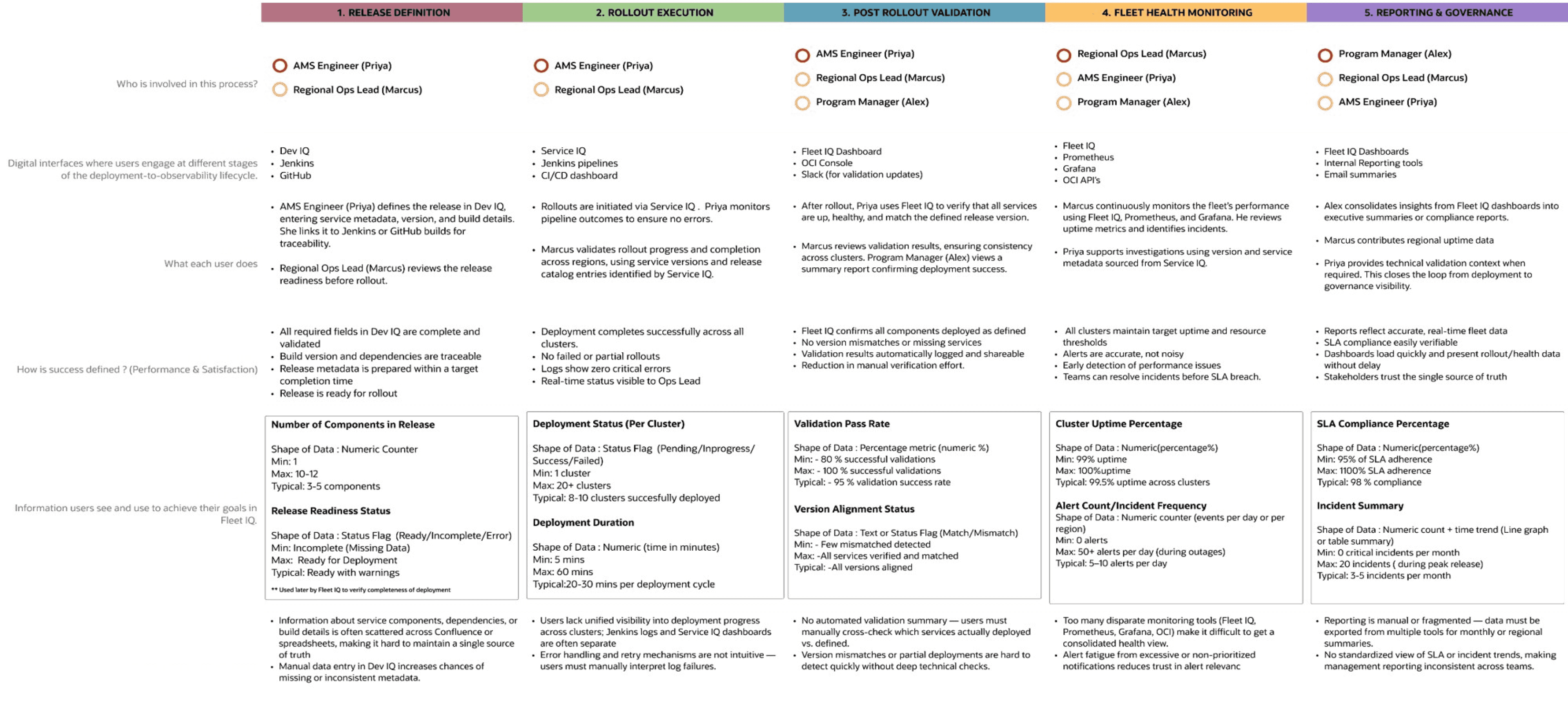
5-stage journey — Release Definition through Governance — with actors, pain points, success criteria, and shape of data per stage.
KEY RESEARCH FINDING
"Stakeholder interviews surfaced the core gap directly — Abhijit named the release validation problem explicitly, and requested the world map view personally. Shape of data research established the operational scale — 3–5 rollouts per month, 8–10 clusters per release, 20–30 min typical validation time — directly informing the dashboard's metric priorities. The design brief was shaped by engineering leadership, not assumed."
PROBLEM
A critical gap — no way to verify
a deployment succeeded
"There is a significant gap in release validation — users cannot currently verify whether deployments have been successful."
— Program Manager · stakeholder interview
"Manual steps currently involve logging into
Bastion Host and running kubectl commands."
Engineering Lead · stakeholder interview
PAIN 01
No release validation
Engineers had no way to confirm whether
a deployment matched the approved release
definition — requiring manual kubectl comparisons
on Bastion Host across environments.
PAIN 02
Fragmented toolchain
Validation was spread across Jenkins, OCI
Console, Grafana, Prometheus, and Slack — no
consolidated view, no proactive alerts, no single
source of truth for post-deployment health.
PAIN 03
No management visibility
VPs had no way to view global fleet health
or customer temperature without manually chasing
ops teams — creating a governance blind spot at
leadership level.
CONTEXT
Fleet IQ — what it monitors and who relies on it
The IQ Eco Space is Oracle OFSS's internal engineering excellence platform — built for managing cloud banking software across hundreds of customer deployments globally. It operates like a NOC centre: five interconnected modules covering the full software delivery lifecycle, from build registration through to AI-driven automation.
Fleet IQ is the monitoring and validation layer — the control room that answers: did our release land correctly, and are all customer environments healthy? It serves engineering teams (SREs, AMS Engineers, DevOps) for operational monitoring, and management (VPs, Program Managers) for deployment health and customer temperature at a glance.
01
Dev IQ
Define & Register — build artifacts, version metadata, dependencies
02
Product IQ
Govern & Approve — release catalog, PLM approvals, board sign-off
03
Service IQ
Deploy & Execute — service lifecycle, release rollouts, artifact tracking
04
Fleet IQ
Validate & Monitor — fleet health, release validation, incident monitoring
This case study
05
Agent IQ
Automate & Optimize — AI agents, predictive insights, MCP automation
Fleet IQ data is collected by an agent deployed in the root namespace of each cluster — sending health, deployment, and telemetry signals to the dashboard on request.
CASE STUDY · FLEET IQ · REDWOOD UCD PROCESS
Fleet IQ — Validate & Monitor
Monitoring layer of the IQ Eco Space — fleet health, release validation, and deployment visibility across Oracle's cloud banking infrastructure.
This case study covers the UX discovery and design phase. The product was in active development at the time of my departure from Oracle — outcomes below reflect design intent and targets, not post-launch measurement.
ROLE
Sole UX Designer
PRODUCT
OFSS · IQ Eco Space
TIMELINE
2025 · 3 Months
INTERFACE
Internal Ops Dashboard
ARTIFACTS
UCD Process · Discovery to High Fidelity
Pre-launch